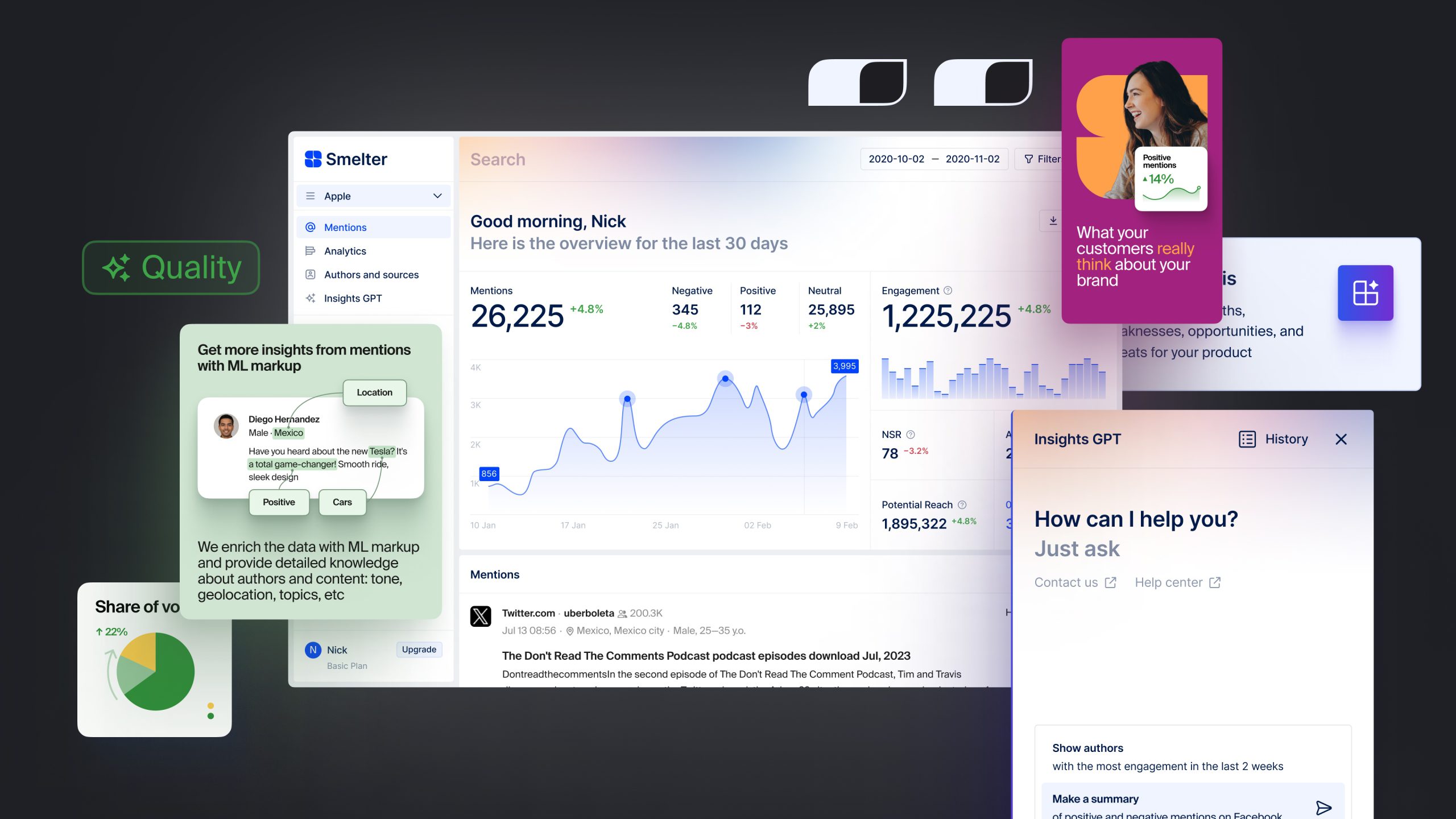
Smelter is Yandex’s B2B AI startup for social listening and marketing analytics. I worked as the sole product designer in a small cross-functional team, owning UX strategy, interface systematization, and end-to-end delivery of core product capabilities.
Over nine months, I led iterative feature delivery across analytics, comparisons, geo insights, AI-assisted workflows, crisis tooling, and communication layers for both users and sales.
TLDR
Role and impact
I covered product design as a full-cycle function: from strategy and interaction architecture to UI system decisions and launch support across product and go-to-market materials.
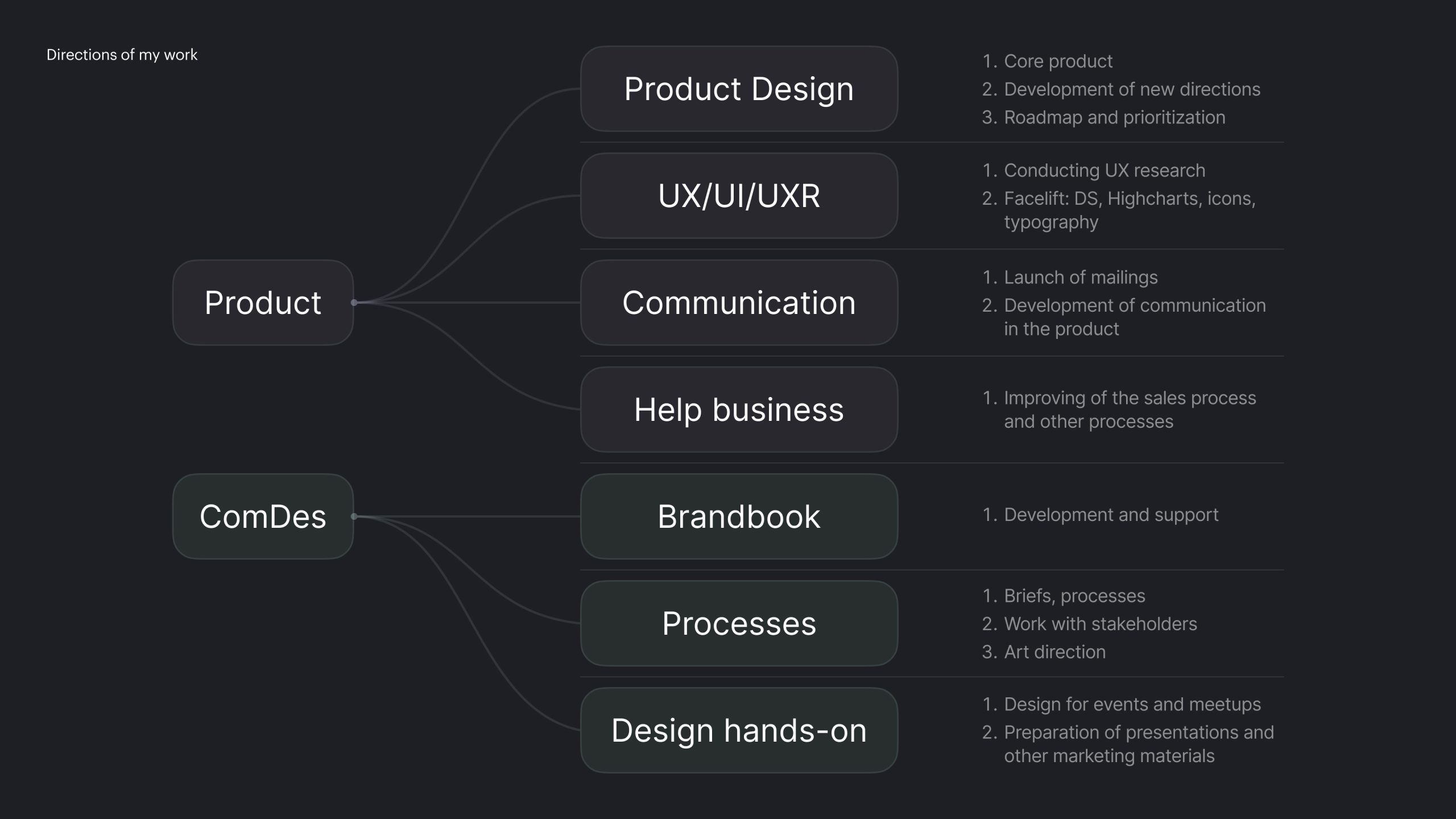
- Built core analytics and comparison capabilities that improved decision quality for clients and agencies;
- Shaped and shipped practical AI workflows, including SWOT generation, auto-tagging, anomaly summaries, and chat assistance;
- Improved critical UX flows, crisis response tooling, user communication, and sales/demo materials;
- Supported measurable business progress over the period: MRR growth, lower acquisition cost, and higher LTV.
These are the eight core case directions.
Analytics and Comparison
2023-2024
Problem
Teams lacked representative comparisons: competitor-only views were often biased, agency workflows needed multi-tag comparison, and country-level geo data was too coarse for regional decisions.
Solution
I expanded analytics with industry benchmarks, flexible tag-based project comparison, and ML-assisted regional geo analytics to support deeper segmentation and planning.
Result
The core analytics layer became more decision-ready: clients could benchmark fairly, agencies could analyze mixed portfolios, and marketers could localize strategy by region.
AI Platform Development
2023-2024
Problem
Manual strategy and analytics tasks were slow: SWOT analysis, mention categorization, anomaly interpretation, and insight generation required heavy expert time.
Solution
I helped shape a practical AI layer: automated SWOT, auto-tagging and mention categorization, AI peak summaries, and a chat-based assistant for explanations and hypotheses.
Result
Smelter moved from raw data toward insight workflows. Users got faster analysis loops and lower entry friction for complex product capabilities.
Crisis Management
2023-2024
Problem
A meaningful group of clients still tracked mentions manually to avoid missing crises, which did not scale and consumed too much analyst time.
Solution
I designed configurable threshold alerts for spikes in mentions, engagement, and high-reach author signals, giving teams an earlier warning mechanism.
Result
The product gained a practical first crisis layer that reduced fully manual monitoring and set a base for future ML-driven risk detection.
UX Improvements
2023-2024
Problem
Users struggled with context switching and weak information hierarchy in key mentions workflows, especially when moving from charts to source mentions.
Solution
I introduced contextual drill-down from analytics into mentions and redesigned the top mentions block to expose core metrics earlier and more clearly.
Result
The main entry workflow became denser and easier to scan, while data exploration became faster without losing analytical context.
Product Communication
2023-2024
Problem
The team shipped features quickly but had weak communication with users both inside and outside the product.
Solution
I launched a monthly update cadence and added in-product communication patterns for feature rollout, onboarding, and contextual guidance.
Result
Communication became systematic, making new functionality easier to notice and giving users clearer product evolution signals.
Improving the Sales Process
2023-2024
Problem
Conversion at the SQL-to-customer stage showed friction, and sales demos lacked a clear, repeatable narrative about product value and pricing context.
Solution
I redesigned the demo communication package: core presentation, modular proof slides, and lightweight quality guides for sales preparation.
Result
The sales team received a more consistent demo framework that reduced preparation ambiguity and made value framing clearer in client meetings.
Prioritization Framework
2023-2024
Problem
The team needed a practical way to prioritize startup work, while default ICE scoring was too abstract and often caused debate.
Solution
I adapted ICE into a product-specific framework with clearer signals: customer and expert feedback, UX research evidence, team confidence, and effort.
Result
Prioritization became easier to discuss and operationalize, with a shared scoring logic better matched to the product stage.
Communication Design
2023-2024
Problem
As Smelter scaled, communication design requests increased and quality control through internal production channels became harder.
Solution
I created a practical brandbook and communication design rules to speed up requests, improve handoff quality, and keep visual consistency.
Result
The team got a clearer operational system for marketing materials, events, and external communication assets.
Outro
This work was less about isolated screens and more about building a product operating system: clearer analytics decisions, faster AI-assisted analysis, more practical crisis workflows, and stronger communication around the product.
As a solo designer in a startup environment, I connected product, UX, and communication design into one delivery loop and helped move Smelter toward a more scalable product model.
Over this period, the business outcomes were also clear: MRR grew, CAC decreased, LTV increased, and the overall LTV/CAC ratio improved.