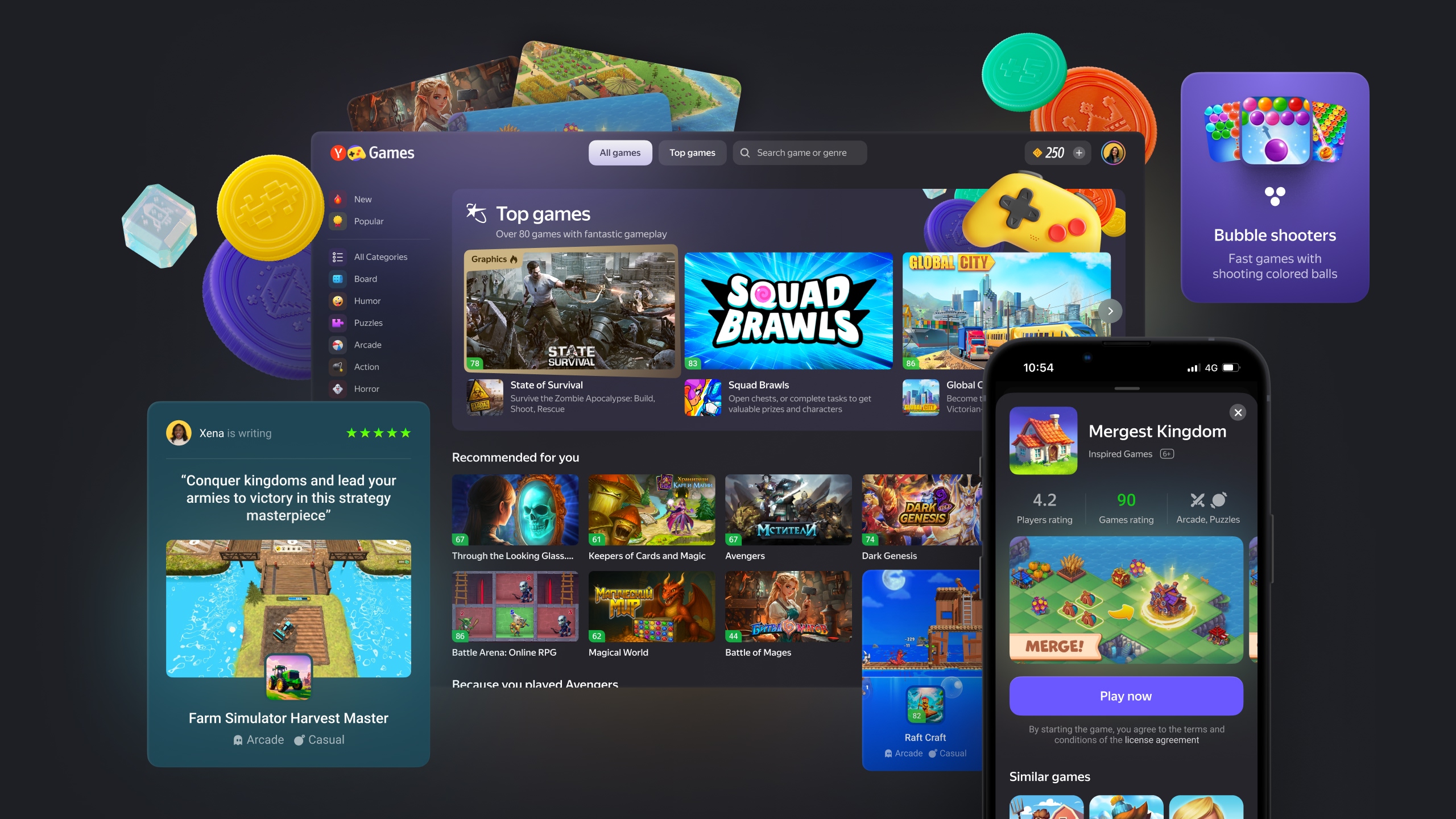
Yandex Games is a browser gaming platform with an audience of about 90 million monthly active users. I worked in a product manager + designer pair and was responsible for improving the discovery flow. This included the homepage with recommendations, game previews, categories, search, and the game page.
TLDR
Role and impact
I owned design in discovery experiments, from hypothesis generation and prototyping to experiment data analysis. My main projects were:
- Researched different types of game previews and launched a new game page format;
- Developed and tested new formats to diversify the game feed, which improved both average playtime per user and total playtime;
- Actively participated in shaping the strategy for developing in-app games and ran the first growth experiments for the in-app games audience. Achieved double-digit growth in high-quality in-app players;
- Prepared and tested a concept for the future product, which outperformed the current version in SBS tests.
Below, I describe these projects in more detail.
Game Preview
2024-2025
+2.2%
total playtime
Problem
Users mostly discovered games through short trial play sessions. However, games were heavy, and loading time made this behavior inefficient both in terms of user value and long-term retention.
Solution
We tested several preview formats and eventually replaced the old format with a full game page that provided information about the game without hurting business metrics.
Result
The chosen format delivered steady engagement growth, increasing total playtime by +2.2%, and created a stronger foundation for future experiments.
Feed Diversity
2024-2025
+5.5%
avg playtime per user
+3.4%
total playtime
Problem
Users were getting too little context when choosing games from identical, repetitive recommendation rows and small covers.
Solution
I diversified the catalog. I added galleries with social proof. I created collections with larger video previews. I launched an experiment to increase the size of game tiles in the catalog.
Result
This series of iterations improved discovery quality and led to cumulative growth in both playtime per user and total playtime.
In-app Growth
2024-2025
+20%
60 sec+ players
+6-8%
total playtime in-app
Problem
The product depended on advertising revenue and did not have a mature strategy for developing in-app games inside the app.
Solution
We launched the first stage of in-app games catalog development. This included both a dedicated section for such games and the logic for promoting them inside the app. In parallel, the business development team was actively bringing new in-app games into our catalog.
Result
The first wave of experiments showed strong growth, including +20% growth in the number of high-quality players and +6–8% growth in total in-app games playtime inside the app.
Concepts
2025
75.8% / 24.2%
SBS new vs old version
Problem
After the initial launches of in-app games, the product needed a broader view of navigation.
Solution
I created and tested a concept for the future that rethought game navigation inside the app and the main user flow.
Result
In comparative analysis, the concept outperformed the old version, and the team began partial implementation.
Outro
At Yandex Games, I worked on the full discovery cycle: from the first impression in the catalog to deeper engagement inside the product. Through multiple experiments, we improved key engagement metrics and built a strong foundation for further development.
Alongside gradual improvements, this work also resulted in a validated concept for the next stage of the service, which is now being partially implemented by the team.
For me personally, this was also a year of experiments not only in the product, but also with coded prototypes and deep involvement in analytics and quantitative research.